Purposd Wellness Fact
Understanding survival mode
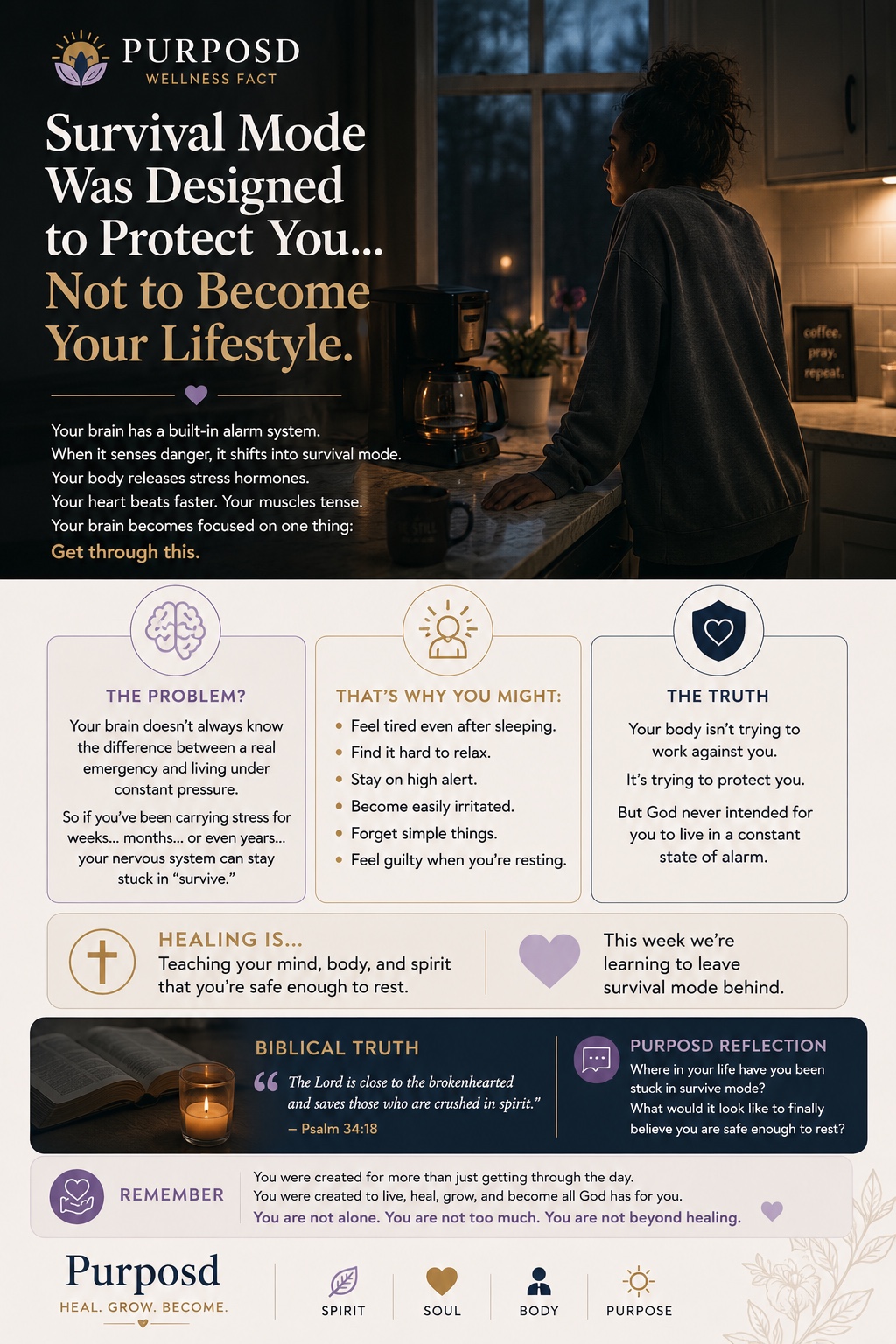
Your brain has a built-in alarm system. When it senses danger, it shifts into survival mode. Your body releases stress hormones. Your heart beats faster. Your muscles tense. Your brain becomes focused on one thing: Get through this.
This response was designed by God to protect you in moments of genuine danger. The problem is that your nervous system does not always know the difference between a real emergency and the ordinary pressures of daily life.
The Problem?
Your brain doesn't always know the difference between a real emergency and living under constant pressure.
So if you've been carrying stress for weeks... months... or even years... your nervous system can stay stuck in “survive.”
That's Why You Might:
Common signs of survival mode
- Feel tired even after sleeping.
- Find it hard to relax.
- Stay on high alert.
- Become easily irritated.
- Forget simple things.
- Feel guilty when you're resting.
The Truth
Your body isn't trying to work against you.
It's trying to protect you.
But God never intended for you to live in a constant state of alarm.
What Survival Mode Actually Looks Like
Most people think of survival mode as something you enter during a crisis — job loss, grief, a relationship ending, or a medical emergency. And while that is true, survival mode can also develop slowly, over time, through ongoing stress, chronic pressure, unprocessed pain, or an environment where you never felt fully safe.
The difficulty is that when survival mode becomes your normal, you may stop noticing it. The hypervigilance feels like responsibility. The inability to rest feels like dedication. The emotional numbness feels like strength. The constant mental activity feels like problem-solving.
But your nervous system is still in alarm — still scanning, still bracing, still preparing for the next threat.
Why This Matters for Your Healing
Purposd is built around the belief that lasting transformation involves the whole person — spirit, soul, and body. Your nervous system is part of your body, and it is deeply connected to how you think, feel, pray, relate, and make decisions.
Understanding what survival mode is doing in your body does not replace faith. It deepens it. When you understand why you feel the way you feel, you can stop judging yourself for it and begin addressing it with honesty, compassion, and God's help.
You are not spiritually weak because your nervous system is exhausted.
You are human — and you may have been carrying more than any one person was meant to carry alone.
“The Lord is close to the brokenhearted and saves those who are crushed in spirit.”
— Psalm 34:18
Healing Is...
Teaching your mind, body, and spirit that you are safe enough to rest.
This week we're learning to leave survival mode behind.
Purposd Reflection
Take a moment with these two questions:
- Where in your life have you been stuck in survive mode?
- What would it look like to finally believe you are safe enough to rest?
Remember
You were created for more than just getting through the day.
You were created to live, heal, grow, and become all God has for you.
You are not alone. You are not too much. You are not beyond healing.
Whole-Person Reflection
Spirit · Soul · Body Check
Spirit
Survival mode can make prayer feel like another task. Today, your spiritual practice is permission — permission to stop performing and simply rest in God's presence. “Be still and know that I am God.” (Psalm 46:10)
Soul
Name one belief that has been keeping you in survive mode. Common ones: “Everything depends on me.” “I can't afford to slow down.” “Resting means I'm falling behind.” Where did that belief come from?
Body
Your body has been working hard to protect you. Today, give it a small signal of safety: 5 slow breaths, a short walk, a full glass of water, 10 minutes without a screen. Small signals help your nervous system begin to shift.
This Week's Step
One Signal of Safety
This week, choose one daily practice that sends your nervous system a signal of safety:
- 5 slow, intentional breaths each morning before checking your phone.
- A short walk without music or podcasts — just presence.
- One meal without multitasking.
- 10 minutes of stillness before sleep.
The goal is not to fix your nervous system overnight. The goal is to begin teaching it — one small, faithful moment at a time — that healing is possible.